Will your veterinary software still be fast at 6 p.m.?
At 6 p.m., when thousands of clinics are invoicing at the same time, a centralized architecture can become a bottleneck. Here is how VetCoreSolution separates data isolation from load distribution.

Pierre Bony
President, co-founder and CTO
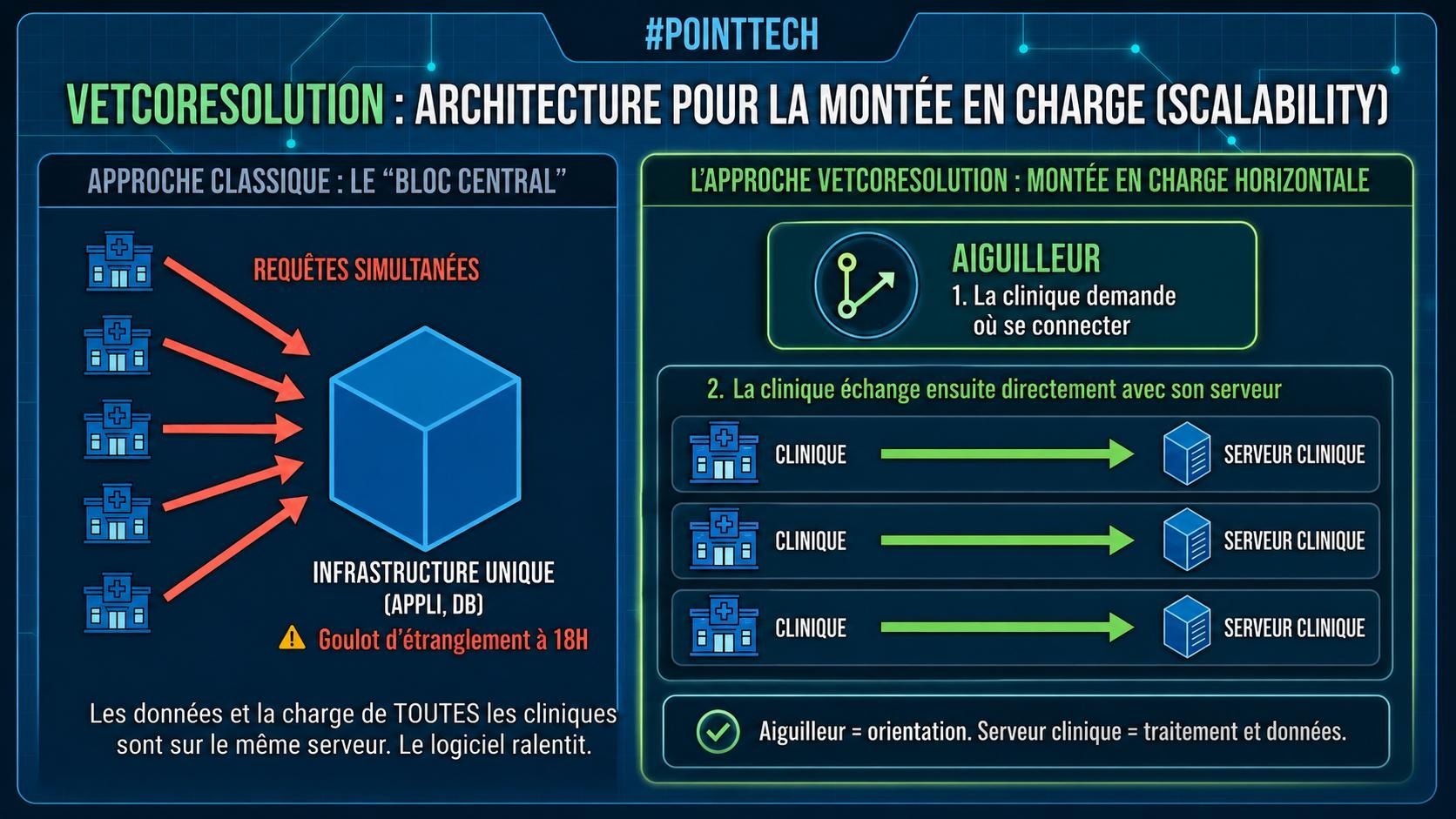
Your veterinary software is fast today. But will it still be fast at 6 p.m., when thousands of clinics across France are using it to invoice at the same time?
That is the challenge of handling increasing load: allowing the software to grow without slowing down.
When everyone shares the same bottleneck
In many architectures, accommodating more users means making the same central block larger: one application, one database, and one infrastructure, all pushed progressively towards their limits. The result: at peak times or during rapid adoption, everyone shares the same bottleneck. And the software slows down.
Two problems, two answers
- Data isolation: each clinic retains its own single-tenant database.
- Load distribution: these databases are distributed across independent clinic servers.
The secret? An Aiguilleur
It has one highly specialized role: it knows where each clinic is hosted and immediately directs the user to that clinic’s dedicated server.
- It does not process consultations.
- It does not calculate invoices.
- It does not manage inventory.
- It simply routes users.
What does this change for you in practical terms?
When a new clinic joins us, it does not add to the daily load experienced by the others. The Aiguilleur directs it to the most suitable server based on its size, network, or geographic area.
And if the network grows? We add another independent server. The operation remains transparent to existing users and increases capacity without concentrating the entire load in one place.
The cloud is not the point
Scaling failures do not always come from bad code. Sometimes they come from an architecture that was never designed to grow. The cloud is not the point. The architecture behind the cloud is.
At CoreFactor, the reliability of your daily work is built into our foundations.